Michael Miscamble on Artwashing in Architecture
ArchitectureAu Asks the Brisbane architect, “When does the relationship between art and architecture go from good to bad, and how do we avoid ‘artwashing’?”
by Michael Miscamble
9 Oct 2025
There’s little doubt that architecture has a long-standing and intertwined relationship with art, with art often manifesting in – or as – architectural form, facade or standalone sculpture. Art can be used to “do good”: to improve a civic interface, educate the public, or signify the values and skills of a local community. But at its worst, architecture’s “artistic” side can result in outcomes that are tokenistic, offensive or purely commercial. When does the relationship between art and architecture turn sour? And how do we avoid “artwashing”?
The best outcomes begin with an authentic vision that seeks to harness local artists through a collaborative and inclusive process, achieving a narrative or provocation that reflects the community it grows from.
When architects and artists engage with local culture, its history and values, we become conduits of that community identity, bringing to life a deeper connection to place. And when we harness collective narratives and undertake shared creation, the many hands of collaboration can sculpt something genuinely delightful.
Whether it stems from grassroots community activism or top-down planning requirements, the synthesis of art and architecture must employ a respectful process to achieve credible outcomes.
Perhaps the sour outcomes arise from non-contextual thinking, imposing external iconography and decorative afterthoughts that seek to displace rather than enrich.
Artwashing, by its etymology (a blend of “art” and “whitewashing”), suggests the covering up of something more sinister; however, our experience curating and creating public installations at Urban Art Projects benefits from a well-honed process employed by local governments and architectural practices. And their clients undertake a considered approach even without legislative requirements, because it embeds integrity and trust in the artistic pursuit of placemaking.
So, when architects and artists nurture moments in our daily lives that make us smile, wonder or learn, this is where the fusion of public art and architecture becomes an exquisite extension of our own civic identity.
#Related Articles
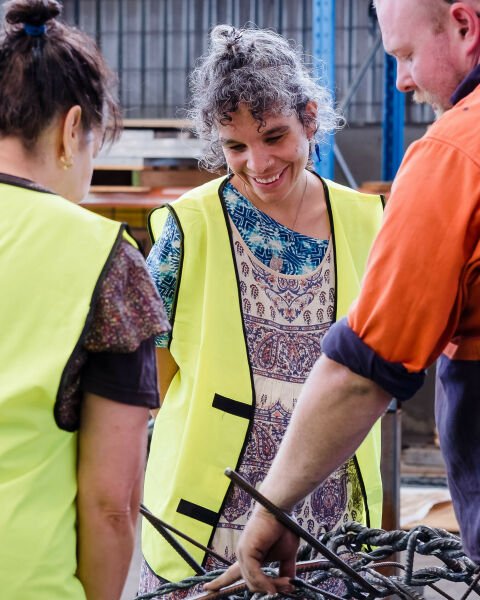
Five Questions with Elisa Jane Carmichael
Quandamooka woman and multi-disciplinary artist Elisa Jane Carmichael was born in Brisbane. Her works draw inspiration from her salt-water heritage and her connections to country, building upon a foundation of cultural knowledge and practice that has been passed down by her family.
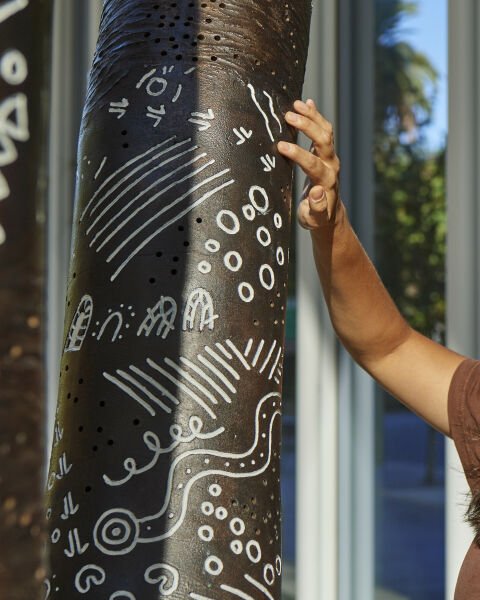
Jarni McGuire's Goodjal ba Ngoonii Koorndaam
Noongar artist Jarni McGuire's work for Brookfield Place's One the Esplanade in Perth illuminates cultural heritage that speaks to place, coming together, and celebration.
Public Art Highlights of 2025
Six Curators Present Notable Public Art Projects Shaping the Year